How Legacy Banking Structures Are Holding Back Insurance Groups
Insurance groups have modernised underwriting models, capital frameworks and regulatory
reporting.
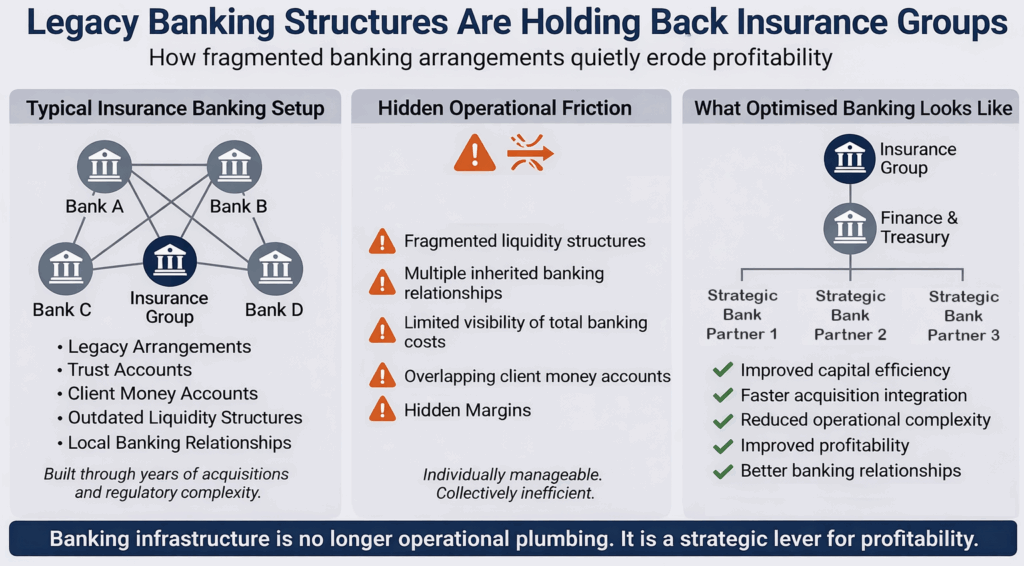
Yet many continue to operate inefficient legacy banking infrastructures built through years of acquisition layering and regulatory constraint.
Across brokers, managing agents, MGAs and P&I clubs, common characteristics include:
- Multiple inherited banking relationships
- Overlapping trust and client money accounts
- Fragmented liquidity structures
- Loss of visibility resulting from increased automation
Individually, these arrangements appear manageable. Collectively, they create recurring drag on profitability.
In an environment of capital discipline and margin pressure, banking architecture warrants strategic attention.
I have worked with dozens of Insurance Finance Leaders to help them figure out the best approach to ensure they have optimised banking arrangements through using a simple process that identifies blockages and profit leaks and provides short and medium term solutions.
Insurance groups that address banking structurally position themselves to:
- Integrate acquisitions faster
- Improve capital and working capital efficiency
- Reduce operational friction
- Enhance governance transparency
- Strengthen long-term banking relationships
- Improve profitability
If you suspect structural banking inefficiencies across entities, trusts or client account arrangements, I’d be happy to share the diagnostic framework we use with Insurance Finance Leaders.