Corporate Banking Has a Visibility Problem
Here’s What Treasurers Told Us at EuroFinance 2026
Corporate treasury has changed enormously over the past decade. Technology has improved, data has become more accessible and treasury teams have become increasingly sophisticated.

Yet one surprisingly fundamental problem remains: many large companies still cannot confidently determine whether they are getting good value from their banks.
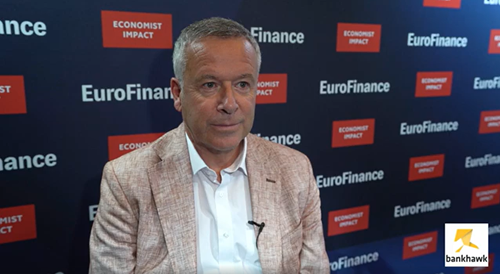
At EuroFinance Barcelona 2026, Bankhawk surveyed corporate treasury and finance leaders about how they manage, measure and benchmark their banking relationships.
The results point to a significant information gap between corporates and their banks.
Bank fees remain remarkably difficult to benchmark
We asked treasury and finance leaders which aspects of their banking relationships were most difficult to independently measure or benchmark.
80% identified bank fees and transaction charges, making this by far the most commonly cited area. Payment costs followed at 53%, while 27% highlighted FX rates and margins.
This matters because corporate banking costs are rarely contained in a single, easily identifiable number.
A large corporate relationship can encompass thousands of individual transaction charges, account fees, payment costs, FX spreads, borrowing margins, deposit returns and other sources of value for the bank.
Individually, many of these may appear relatively small. Across multiple banks, countries, entities and currencies, however, they can become very significant.
The challenge for treasury is not simply obtaining the data. It is turning that data into a reliable picture of what the organisation is actually paying and whether those costs are competitive.
Most corporates don’t have complete visibility
Perhaps the most striking finding concerned visibility.
73% of respondents said they had only partial or no visibility into the total value their banks earn from their relationship.
And when we asked about confidence in validating bank pricing against agreed terms and market benchmarks, 93% were not fully confident that they could do so.
Banks quite reasonably understand the economics of their corporate relationships in considerable detail. They know the revenues generated across products, geographies and services, risk and liquidity and regulatory costs.
The corporate on the other side of that relationship may have a much less complete picture.
What are our banks earning from us? Are we receiving the pricing we negotiated? How does our pricing compare with the market? And are we allocating our banking business efficiently?
Without reliable answers, even a well-managed treasury function can leave significant value on the table.
Benchmarking isn’t happening frequently enough
There was another finding that caught my attention.
Only 27% of respondents had independently benchmarked their principal banking arrangements within the previous 12 months.
The remaining 73% had either benchmarked them longer ago, had never done so, or were unsure when it was last done.
This is particularly important in a changing interest-rate, payments and banking environment.
A banking arrangement that was competitive when negotiated several years ago does not necessarily remain competitive today. Pricing changes. Business volumes change. Technology changes. Bank appetite changes. And the economics of the relationship change.
Benchmarking therefore shouldn’t simply be something that happens when an RFP is launched.
It should increasingly be part of continuous treasury management.
Treasurers see an opportunity to improve value
The survey also asked respondents where they believed the greatest opportunities existed to improve value from their banking relationships.
The leading answers were renegotiating banking relationships (48%), reducing bank fees (47%) and improving liquidity (45%). Improving visibility and reporting was cited by 28%, while 26% identified payment-cost optimisation.
What I find interesting about these results is that they don’t suggest dissatisfaction with banks themselves.
Rather, they suggest a need for better information on which to manage those relationships.
Banks are critical strategic partners to large corporates. The objective shouldn’t be to squeeze every last basis point out of a bank or continually move business between providers.
The better objective is a relationship in which both sides understand the economics, pricing is competitive and transparent, and business is allocated in a way that delivers appropriate value to both corporate and bank.
That requires data.
From periodic review to continuous intelligence
Historically, corporate banking optimisation has often been episodic.
A company conducts an RFP. Consultants review its banking arrangements. Pricing is renegotiated. Savings are identified.
Treasury teams should increasingly be able to continuously analyse their banking data, verify the pricing actually applied, identify anomalies, understand the total economics of their banking relationships and compare their arrangements against relevant market benchmarks.
In other words, the question should move from:
“When did we last review our banks?”
to:
“Do we know, today, whether our banking arrangements are competitive?”
Our EuroFinance research suggests that, for many corporates, the answer is not yet a confident yes.
Perhaps the clearest indication of demand was that 93% of respondents asked to receive Bankhawk’s Corporate Banking Benchmark Report.
That tells us something important.
Treasurers don’t necessarily need more banking data.
They need better intelligence from the data they already have.
Brian Weakliam
Founder & CEO, Bankhawk
Bankhawk helps large corporates independently analyse, benchmark and optimise their banking and payments arrangements.
What Treasury & Finance Leaders Told Us at EuroFinance Barcelona
View the survey results here: Bankhawk – Corporate Banking Market Survey – EuroFinance 2026 PDF